Part 1: DOS Testing
In dyeing samples, 1g is about as small as I could go and still have enough fiber to meaningfully measure quantities. (Professional dyers make larger dye samples.) On the flip side, if your goal in sampling is to make binder pages with small tufts of fiber, 1g is kind of a lot. After I had pulled off tufts to make my little dye atlas, I had a lot leftover.
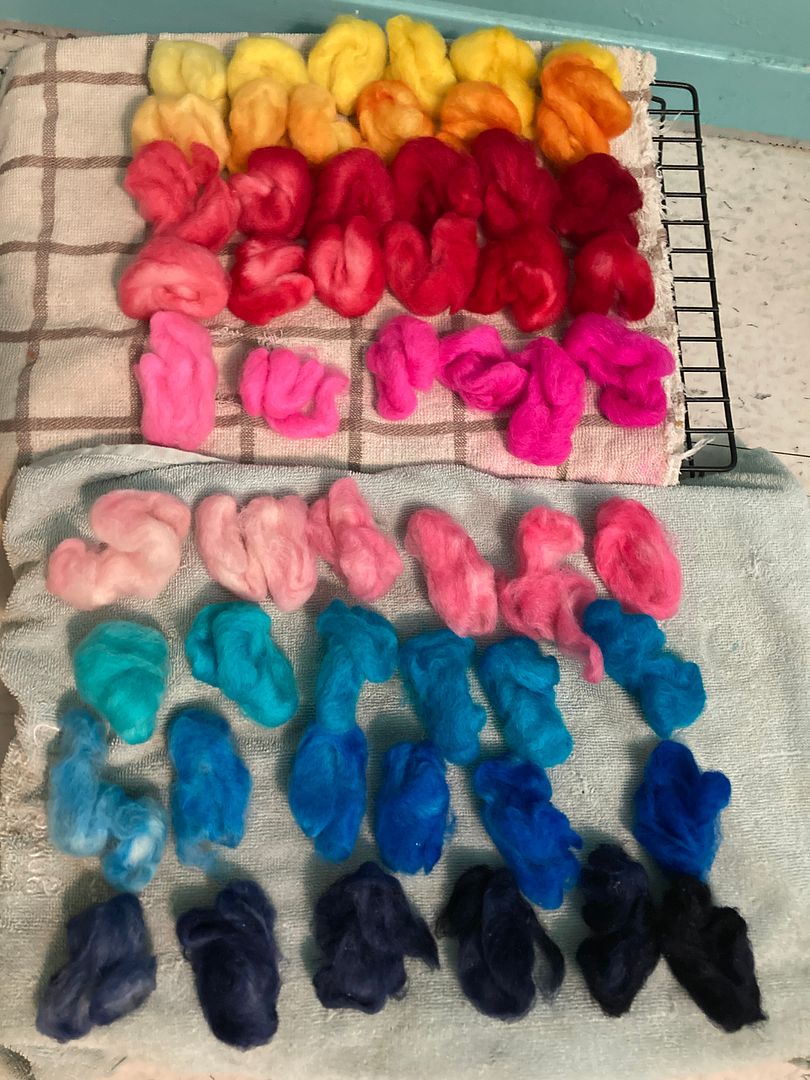
As stated in my last dyeing post, my goal was to try out the dye recipes from Color in Spinning by Deb Menz. But, how to do that? Do I mix up 48 colours, and just hope that I like them? Do I make 48 1g samples, trying to measure the different dye ingredients by counting drops?! I wasn’t sure how I would go about this. But when I saw how much I had leftover from my DOS tests, I had a brainwave. I could approximate the dye recipes by carding.
I didn’t start with Menz’s recipes. That was a bit overwhelming. I started out with Felicia Lo’s colour triangle from her class, “Dyeing Intentional Colour.” This is essentially an extended colour wheel on the outside, with mixes of all three primaries in the middle.
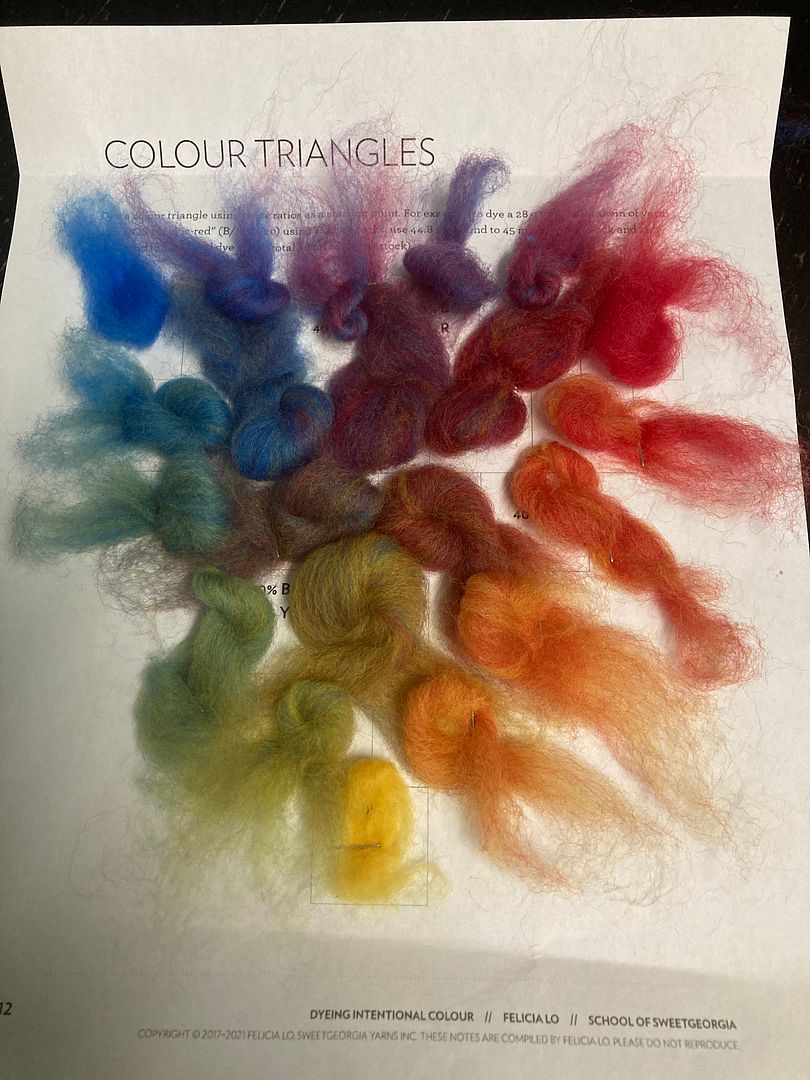
Here’s how I did this. I chose six primaries: golden yellow, fire red, and brilliant blue for RYB; and sun yellow, hot fuscia, and turquoise for CYM. I had six tufts of each dyed colour, at .25%, .5%, 1%, 1.5%, 2%, and 3% DOS. From the six primaries, I set aside the 1% and 1.5% tufts for these triangles.
The 1% tufts became the outer circle. I divided the tufts into appropriate proportions to mix up and make percentages. The 1.5% tufts became the inner part of the circle.
I carded them together, using the word “carding” very loosely when talking about this small a quantity. I used the edge of one handcard and my fingers to shuffle the fibers until they were as mixed as I could get them.
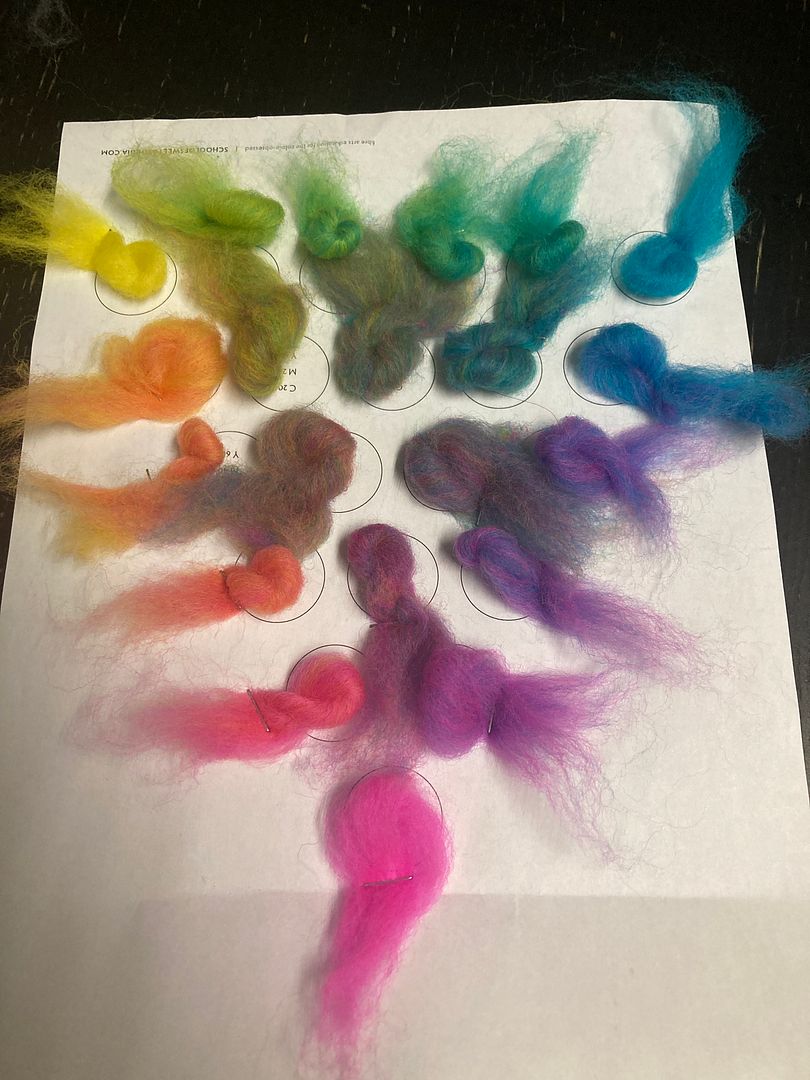
The colours I got were gorgeous. I observed that when all three CYM colours blended, they created greys. But the RYBs created browns. Isn’t that interesting?
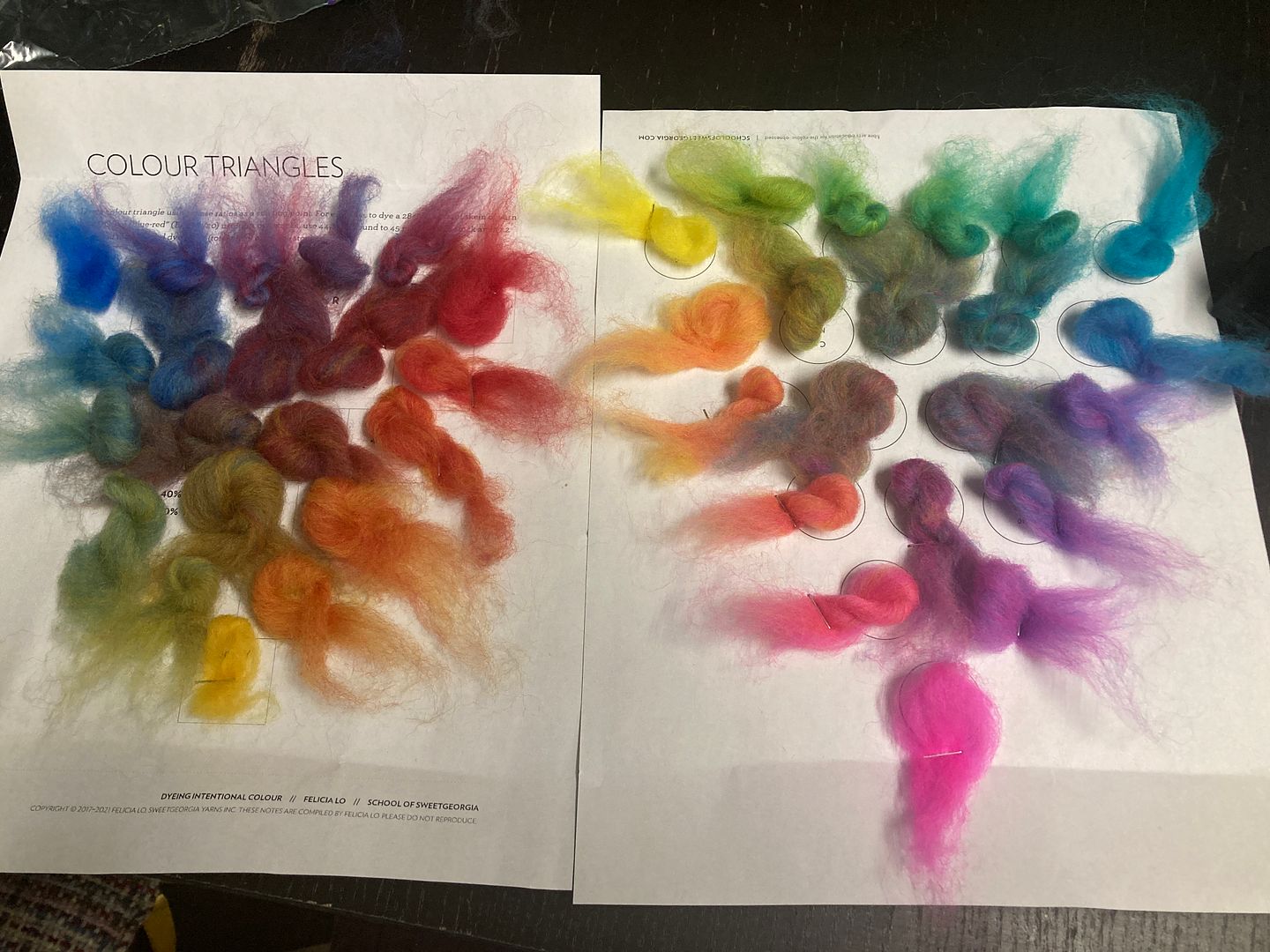
Being carded, these colours are created using optical mixing. This is fundamentally not the same as the chemical mixing that happens when you mix dyes. These optically mixed colours are so appealing because of the complexity of optical mixing that draws you in, your eye puzzling out the dimensions of the mixed dots. I had to be careful not to be misled by this, but to really lean back and squint to imagine what the mixed dye colours would be.
This exercise was super fun. So I decided to go ahead and try it on my adaptations of Menz’s colour recipes.
I say adaptations because I modified her recipes pretty heavily. I rounded them all to be in 5% increments, and some of the reds and purples had to be modified to omit the magenta. Also, she actually gives 56 recipes – she gives 8 hues each of reds and blue-greens. I just chose 4 of each of the 12 hues.
If you look at the recipes on pp. 82 and 83, a pattern begins to emerge. For each hue, she gives four varieties:
- Intense, at 2% DOS
- Dull, usually with a little complement added, at 1% DOS
- Dark, usually with black added, at 3% DOS
- Pale, at .5% DOS.
It’s a little confusing to read the list, because she labels the Dark and Dull colours, but not the Intense or Pale ones. But as I copied the recipes into my journal to calculate how much dye I would need to mix, the pattern became pretty obvious. I decided to organize my samples to make the differences really clear.
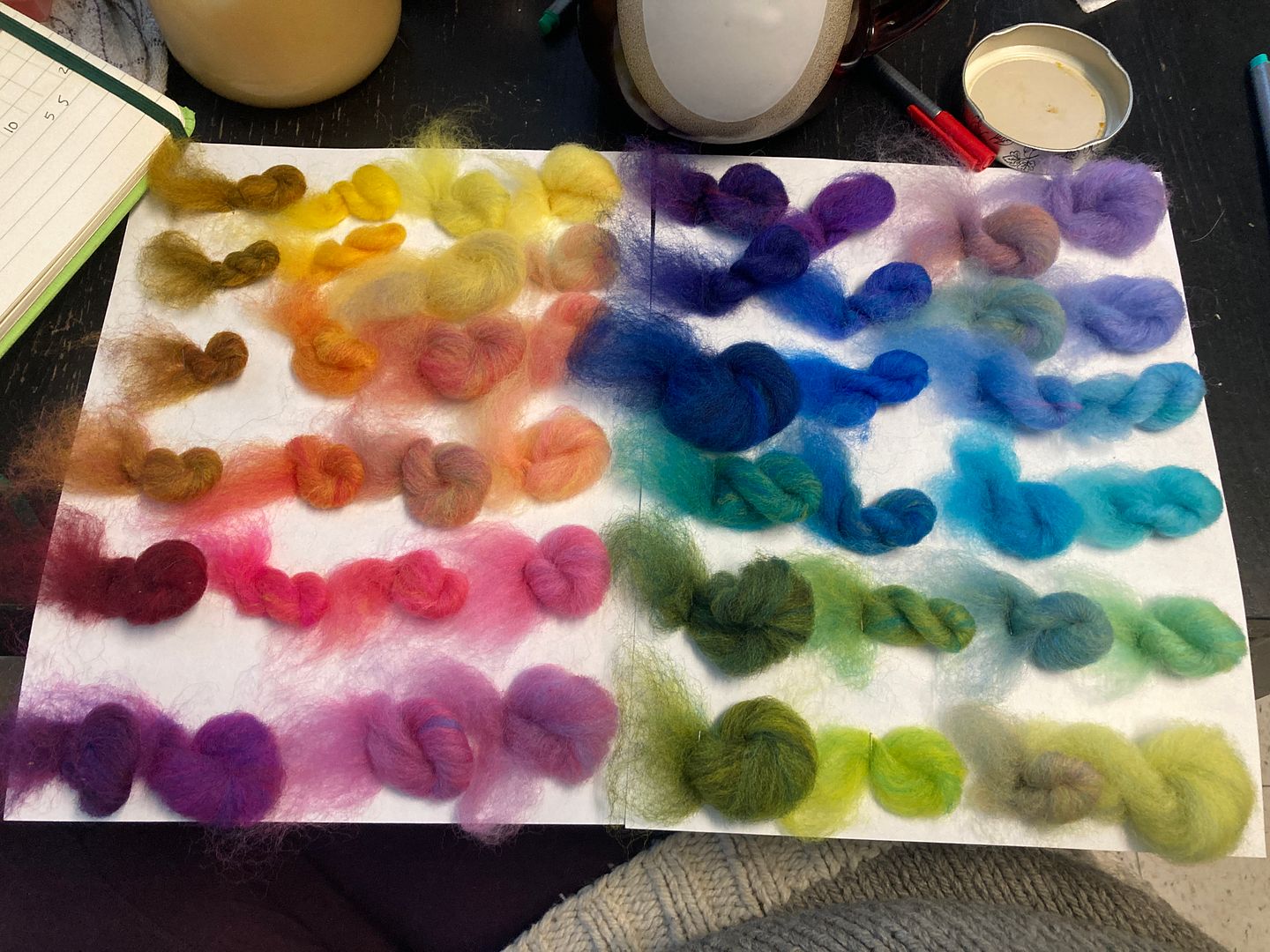
Here is the result. I used the 3% tufts to make the Dark tests, the 2% tufts to make the Intense tests, the .5% tufts to make the Dull tests, and the .25% tufts to make the Pale tests.
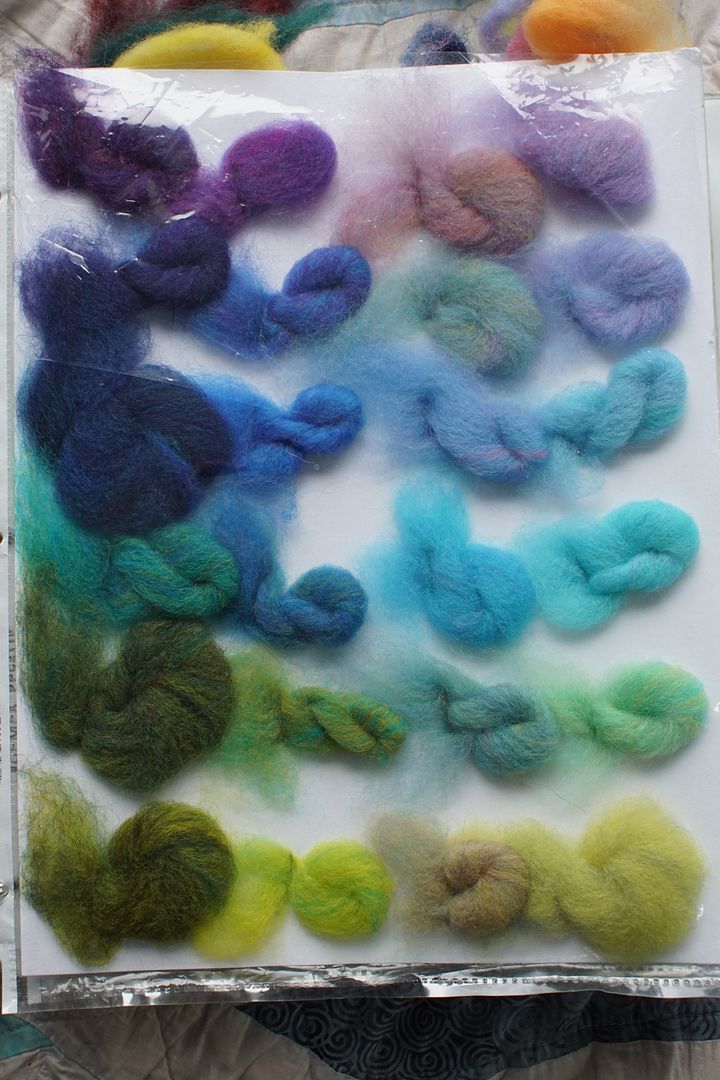
Are they beautiful to look at? YES. To this day, I just gaze at them and smile! And they tell me loads about how the colours will act in carding. However, in choosing dye recipes, I have to be cautious, again doing the lean-back-and-squint.
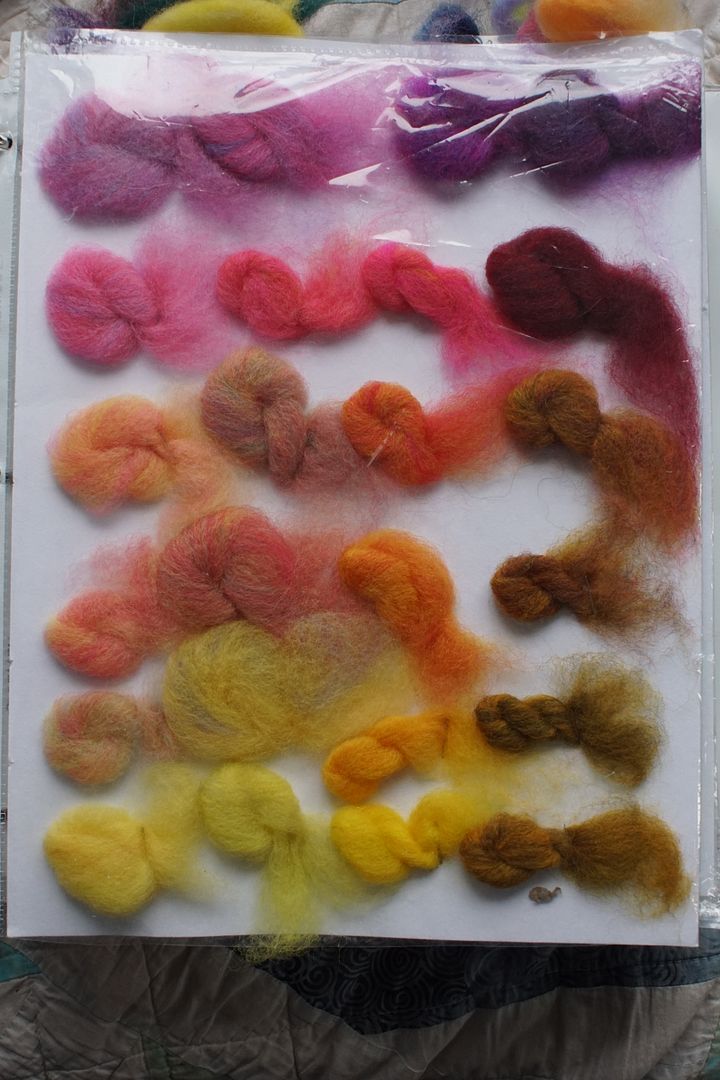
I know accuracy is going to be all over the place with a toy like this. But at least it helped me understand what is going on in the dye recipes, so if there were some I didn’t like, I could replace them. (I was definitely convinced of the importance of the violet dye. Look at those purples!) In the end, this exercise gave me enough confidence that I could mix dyes to get me through 53 oz of dye experiments.
In the end, I used 39 recipes based on the carded experiments from Deb Menz’s formulas. I based 8 further formulas on Felicia Lo’s colour triangle experiments, and I made one simple one up myself. I maintained Deb’s framework (One each of Intense, Dull, Dark, and Pale for each of 12 hues), and the DOS she used for each.
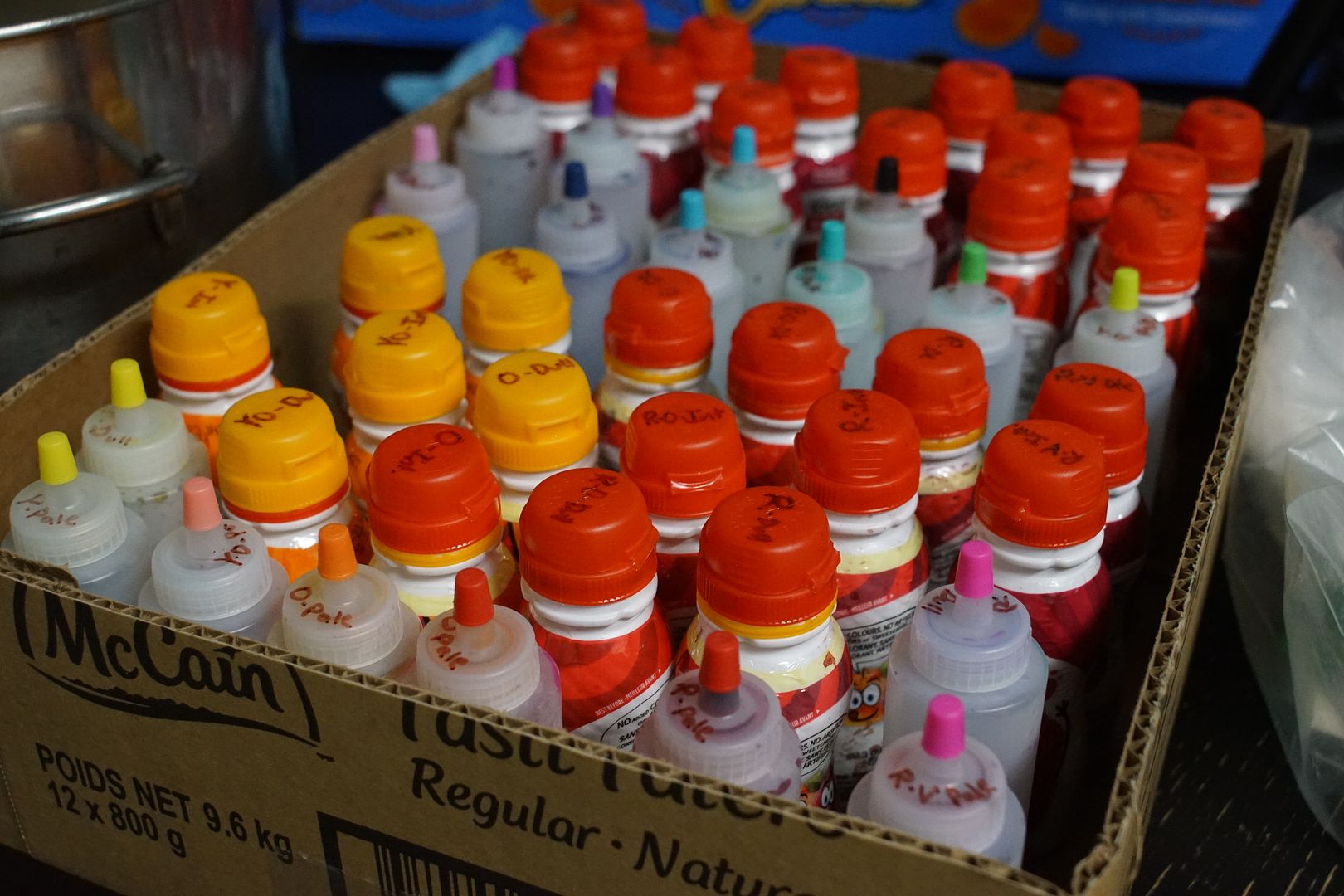
Next time, I start putting dye on top in a serious way, and I see how close my carded approximations were to the dyes they inspired!


One thought on “Dye School Part 2: Dye Recipe Approximations with Carding”